
I remember the first time I tried to teach the Age of Absolutism to a room full of 11th graders who were far more interested in whether we’d have a snow day than in the power structures of 17th-century France. I had spent hours crafting what I thought was a brilliant lecture, complete with detailed slides about Louis XIV and the divine right of kings. About 12 minutes in, I looked out at a sea of blank faces. One student in the back row was openly yawning.
Not one was wondering, “What does Absolutism mean to me?”….to them, it was just boring droll.
I realized in that moment that I had made a classic mistake: I was teaching the topic from the outside in, drowning them in names and dates before they understood the fundamental question that makes this era so gripping. What would it actually feel like to live under a ruler who claimed to be answerable only to God?
That question became the anchor for every lesson I taught on this subject after that day. When I stopped trying to cover everything and instead focused on that single, unsettling idea, the engagement in my classroom shifted noticeably. Students who had never volunteered an opinion started raising their hands. They wanted to argue about whether any human being should wield that kind of power. They started connecting the concept to modern leaders they saw in the news.
That’s the moment I understood that teaching the Age of Absolutism isn’t about cramming 100 years of European history into 2 weeks. It’s about helping students wrestle with a form of government in which 1 person holds total control, and then letting their natural curiosity draw them into the historical details.
My period 4 World History class was my toughest crowd during those early years. More than half the students were taking the course for the second time, and many had decided history was simply a parade of dead people they’d never understand. When I introduced absolutism through a primary source from the court of Louis XIV that described the elaborate rituals surrounding the king’s waking and dressing, something clicked.
They were horrified and fascinated in equal measure. One student muttered something about the king being a celebrity and a dictator rolled into one. That comment became our shorthand for the unit, and it came from a student who hadn’t turned in a single assignment the previous quarter.
By the time I left the classroom in 2018 to begin training K-12 teachers on student-centered learning full-time, I had taught World History every single year of my teaching career. That’s 11 consecutive years of wrestling with how to make the Age of Absolutism click for students across wildly different settings, from a nationally ranked academic school to a Title I CTE school where many students were balancing coursework with part-time jobs and family responsibilities.
I’ve worked with more than 1,700 students over my career, and I’ve found that this era resonates when you make it visceral before you make it academic. My books The Classroom Dichotomy and Teaching When You Have Nothing Left both explore this philosophy in depth, and it’s the approach I now teach other educators to use: first strip a dense topic down to its emotional core. What did absolute power feel like for the common people who lived under it? Once students connect with that question, the definitions and timelines follow naturally.
What Does Absolutism Mean? A Clean Definition for Students
Students need a definition they can hold onto before they dive into the complexities of the 17th and 18th centuries. Here’s the one I used to write on the board at the start of every unit: Absolutism is a form of government in which a single ruler holds unrestricted political power, unconstrained by a legislative branch, constitution, or competing authority.
During the Age of Absolutism, roughly spanning the late 16th through the 18th century, absolute monarchs across Western and Central Europe justified their authority by the divine right of kings, claiming they served as God’s representatives on earth and therefore could not be legitimately challenged by any human institution.
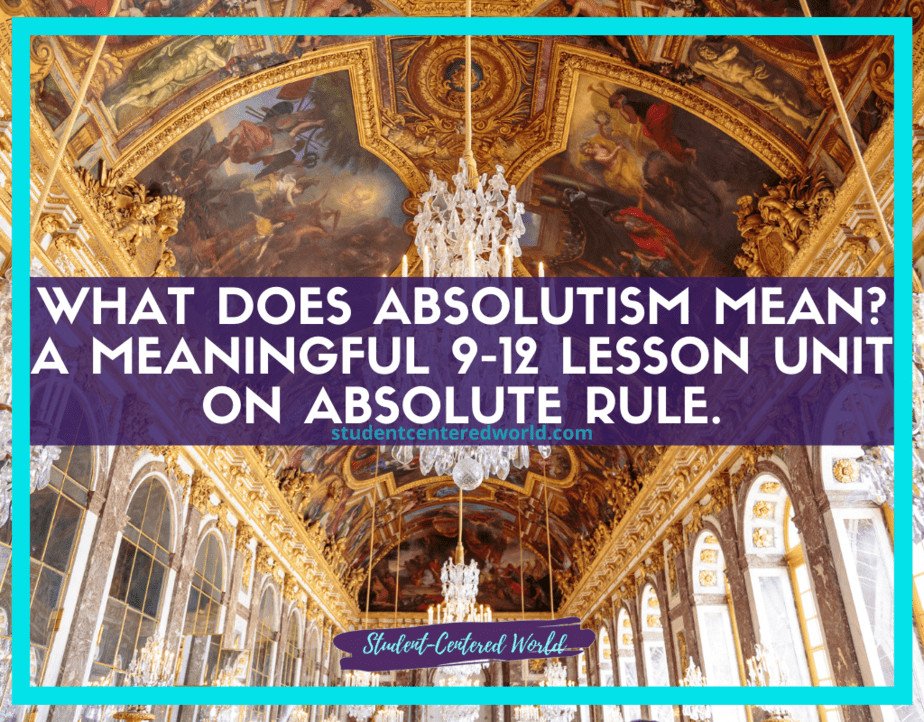
That definition gives students an anchor. I followed it immediately with a concrete example. Louis XIV of France, the Sun King, embodies absolutism more clearly than any other European monarch. He consolidated the royal court at Versailles, where he kept the nobility occupied with elaborate ceremony while he made all meaningful decisions himself. When my students heard that a grown man required dozens of people to watch him eat breakfast as a sign of his absolute authority, they started to grasp how deeply this societal structure penetrated daily life. The Age of Louis XIV became our central case study for understanding royal absolutism at its peak.
The Divine Right of Kings and the Roots of Absolute Power
The concept of divine right didn’t emerge from nowhere during the Age of Absolutism. Its roots stretch back through the Middle Ages, but the 16th and 17th centuries gave it a sharper political edge. King Henry VIII’s break with Rome in the 1530s provided a crucial precedent: a European monarch could reject the authority of the Pope and position himself as the supreme head of both church and state within his realm. That move planted a seed that would grow into full royal absolutism over the next century and a half.
When I taught this connection, I walked students through a simple chain of reasoning. Henry VIII needed a male heir. The Pope refused to annul his marriage. Henry’s solution was to declare that no external authority, not even the papacy, could override the will of an anointed king. That logic, pushed to its extreme, became the foundation for absolute monarchies across Europe. A king who answers only to God leaves Parliament, local nobles, and common people with no legitimate grounds for resistance.
The Thirty Years’ War, which devastated the Holy Roman Empire between 1618 and 1648, accelerated this trend. The conflict left much of Central Europe exhausted and desperate for stability. In that vacuum, rulers who promised order through concentrated power found willing subjects. The peace treaty that ended the war reinforced the principle that sovereign rulers held authority over their territories without outside interference. My students often asked why people would accept this arrangement. The answer is straightforward: after decades of religious warfare that killed millions, the promise of stability looked like salvation, even if it came at the cost of political freedom.
What Absolute Rule Looked Like in Practice
Textbooks describe absolutism in abstract terms. I found that students needed to see it operating in concrete, everyday contexts before the concept stuck. My go-to example was always Louis XIV’s Versailles. The palace wasn’t just a display of wealth. It was a political machine. By requiring the French nobility to reside at the royal court for part of the year, Louis removed them from their core provinces, where they might build independent power bases. He turned them into supplicants who competed for the honor of holding his shirt while he dressed.
I used to have students analyze a short excerpt from the Duc de Saint-Simon’s memoirs, which describe the stifling ritual of court life in vivid, gossipy detail. After reading it, I asked them to write a 3-sentence response from the perspective of a noble forced to attend the king’s morning ceremony. The responses were consistently sharp. Students described feelings of humiliation, resentment, and grudging admiration. That exercise, which took about 20 minutes, did more to cement their understanding of absolute monarchy than any PowerPoint presentation I ever delivered.
The English Civil War offers a powerful counterpoint. While France moved toward concentrated royal power, England was wrestling with the opposite impulse. The conflict between Charles I and Parliament, culminating in the king’s execution in 1649, showed that absolutism was not inevitable. The Glorious Revolution of 1688 then established a constitutional monarchy with clear, limited powers for the crown. I always taught these 2 cases side by side. France and England started the 17th century with similar political structures. Their divergence helps students see that history is shaped by specific choices and contingencies, not by some predetermined path.
Connecting Absolutism to the Enlightenment and Revolution
The Age of Absolutism doesn’t make full sense until students understand what brought it to an end. Enlightenment ideas provided the intellectual wrecking ball. John Locke’s concept of the social contract, the idea that legitimate government derives its authority from the consent of the governed, directly challenged the divine right doctrine. Power that came from the people rather than from God left absolute monarchs with no legitimate claim to rule without constraint. This wasn’t abstract philosophy to the people who read Locke’s work. It was a fundamentally new way of understanding their relationship to power.
I introduced Locke right after we finished the case studies on Louis XIV and Charles I. The timing mattered. Students had just spent several days immersed in a world where kings claimed total authority. Hearing Locke argue that absolute monarchy is inconsistent with civil society landed with real force. I asked them to imagine they’re living in 1689 and have just read Locke’s Two Treatises of Government for the first time. What would they do with that knowledge? The discussion that followed often spilled into the hallway after class.
The Enlightenment‘s influence on the American and French Revolutions makes the connection concrete. Students can trace a direct line from Locke’s social contract to Jefferson’s Declaration of Independence. They can see how the absolutist state built by Louis XIV created the conditions for the 1789 explosion, when the common people finally refused to accept the old social order. Louis XVI, unlike his ancestor the Sun King, lacked the political skill and the aura of absolute authority to hold the system together. I always taught the French Revolution as the direct sequel to absolutism, and students grasped the cause-and-effect relationship in a way that memorizing dates never achieved.
Enlightened Absolutism and the Limits of Reform
The 18th century produced a fascinating variation on the absolutist model that deserves attention in any thorough unit. Enlightened absolutism, associated with rulers such as Maria Theresa of Austria and Catherine the Great of Russia, sought to reconcile absolute political power with Enlightenment reform. These monarchs read the philosophes, corresponded with Voltaire, and implemented changes to legal codes and education systems. They wanted the benefits of modernization without surrendering an ounce of royal authority.

I handled this topic carefully with students because it’s easy to overstate how enlightened these rulers actually were. Catherine the Great corresponded with Diderot, but crushed the Pugachev Rebellion and tightened serfdom. Maria Theresa reformed education but remained a committed absolutist who never considered sharing power with a legislative branch. I had students create a simple chart comparing the reforms these rulers implemented with those they refused to consider. The exercise revealed a consistent pattern: enlightened absolutists supported changes that strengthened the state and their own power but rejected anything that threatened their absolute authority. In practical terms, enlightenment stopped at the throne room door.
My Honest Take on Teaching the Age of Absolutism
After 11 years of refining how I taught this unit, here’s what I’d actually tell a colleague who asks for advice over coffee. You can’t cover everything. The list of absolute rulers alone, Louis XIV, Peter the Great, Frederick the Great, Maria Theresa, Catherine the Great, Charles I, Philip II, could fill an entire semester. Pick 3 case studies that let students compare and contrast.
I used Louis XIV for pure absolutism, the English Civil War and the Glorious Revolution for resistance to absolutism, and Peter the Great as an example of a ruler who dragged a reluctant European nation into the great-power system through sheer force of will. Three cases, taught in depth with primary sources, beat a survey of 10 rulers, in which students remember nothing but names.
I also recommend spending at least 1 full class period on the daily experience of common people. Textbooks focus relentlessly on the monarchs, but students connect more readily with ordinary life. What did absolutism mean for a French peasant who never saw Versailles? What changed for a Russian serf after Peter’s reforms? Answering those questions makes the abstract concept of absolute power concrete.
I’ll be straightforward here: the Age of Absolutism Unit Plan I created doesn’t include a dedicated lesson on the daily lives of common people. Its strength lies in giving students a clear, structured grasp of the political machinery of absolutism, the divine right of kings, and the specific rulers who defined the era, all within a tight timeframe that respects how packed a World History curriculum really is.
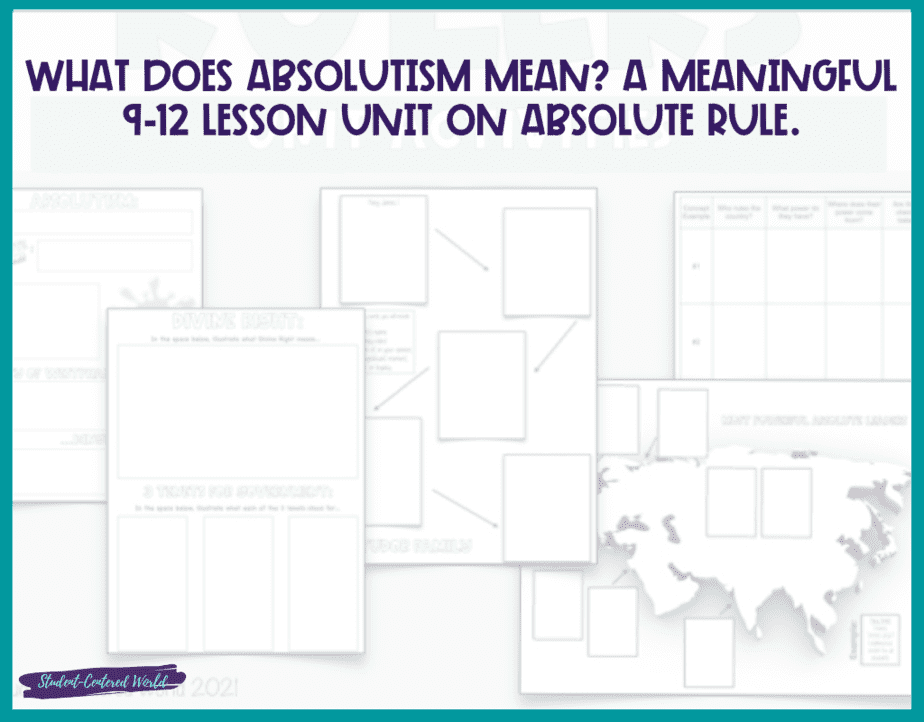
The unit includes 5 distinct activities: a definition of absolutism, profiles of key absolute monarchs, a map activity, and an extended look at the Tudor and Stuart dynasties, all of which are complete with answer keys and extension ideas. It builds the political and institutional foundation students need before you layer on the social history. Adding a supplementary lesson on ordinary life from your own sources pairs beautifully with what the unit already provides, and that combination gives students the full picture without sacrificing either the top-down or bottom-up perspective.
I learned to resist the temptation to rush from absolutism directly into the French Revolution without pausing to let students process what they’d learned. This shift took me the better part of a semester to feel natural, and some students pushed back before they came around. Students need time to sit with the era’s contradictions before they can appreciate the forces that brought it down.
I built in a reflective writing assignment between the 2 units, asking students to evaluate whether they would have supported or resisted absolute rule if they had lived in the 17th century. The responses I’ve collected over the years remain among the most thoughtful pieces of writing I’ve ever received from students.

What do I do when a student says absolutism is just like a dictatorship and refuses to engage further?
I leaned into that comparison rather than resisting it. I would ask the student to list the specific features they associate with dictatorships, and then we would compare each one with what we know about absolute monarchs. The exercise usually reveals that the student has valuable prior knowledge they can bring to the topic. It also opens up a genuine historical question: how did absolutism differ from 20th-century totalitarianism? The role of religion, the persistence of traditional social hierarchies, and the absence of mass propaganda technology all make the absolutist state meaningfully different from Adolf Hitler’s regime or Stalin’s Soviet Union. Students who start out dismissive often become the most engaged once they realize they’re being asked to make distinctions rather than just memorize labels.
How do I teach absolutism when my students have no background knowledge of the Middle Ages?
Start with what they do know. Most students have some awareness of stories with kings and queens, even if they can’t locate the Holy Roman Empire on a map. I built on that cultural knowledge, then quickly filled in the gaps with a focused mini-lecture on the end of the medieval period and the consolidation of nation-states. I never tried to remediate an entire unit on medieval European history. I provided just enough context for them to understand why the 17th century was different from what came before.
How much time should I spend on the divine right of kings?
One full class period is sufficient for most high school courses. I spent the first half of that period on Henry VIII and the break with Rome, then the second half on how later absolute rulers expanded the concept. Students need to understand divine right as a claim to legitimacy, not just a religious idea. The key question is: what practical political work did this belief do for monarchs? Answering that question thoroughly matters more than covering every theological nuance.
What’s the best primary source for introducing absolutism to struggling readers?
The Duc de Saint-Simon’s descriptions of court life at Versailles work remarkably well, even with students who read below grade level. The descriptions are concrete, visual, and inherently dramatic. I provided a heavily excerpted version with vocabulary support, and students rarely struggled to grasp what was happening. The absurdity of dozens of nobles watching a man wake up and eat breakfast grabs their attention fast.
How do I connect absolutism to the Enlightenment without losing student momentum between units?
Build the connection into your closure for the absolutism unit rather than saving it for the opening of the Enlightenment unit. In the final activity of my absolutism unit, I had students read a brief excerpt from John Locke and discuss it as a direct challenge to everything they had just studied. That created intellectual tension that carried over naturally into the next topic. Students arrived at the Enlightenment already curious about how these new ideas would play out.
What’s the most common mistake new teachers make when teaching this topic?
Trying to cover too many absolute monarchs in too little time. I made this mistake repeatedly in my first 3 years. I’d race through Louis XIV, Peter the Great, Frederick the Great, Maria Theresa, and Catherine the Great in a week, and my students would leave the unit unable to distinguish one from another. Depth over breadth really does produce better retention and deeper understanding. Choose 3 rulers, teach them thoroughly, and trust that students will recognize the broader patterns when they encounter unfamiliar monarchs later.
This article was originally published on October 28, 2021.
