
You haven’t even walked into your classroom yet, and you’re already tired…feeling burnt out before school even starts.
Not the good kind of tired from a long day well spent…the other kind. The kind where you’re standing in the school supply aisle at Target, staring at a stack of composition notebooks, and you feel your chest get tight for no reason you can point to.
Everyone around you will call this “teacher burnout.” Your friends will say it. Your family will say it. You might even say it about yourself, because it’s the only word anyone’s given you.
Burnout isn’t one thing…it’s actually three. The problem is, most of us spend all year fighting the wrong one.
What Teacher Burnout Actually Is (Beyond the Buzzword)
Before we go any further, let’s define what we’re actually talking about. Teacher burnout is the physical, emotional, and psychological exhaustion that comes from prolonged exposure to unmanaged workplace stress.
It’s not the same as having a hard week. It’s not the same as being tired on Friday. Those things are stress. Stress is temporary, situational, and usually resolves when the situation changes.
Burnout doesn’t resolve when the grading pile shrinks or the weekend arrives. It lingers. It makes August feel heavy before you’ve even set foot in the building.
I’ve watched teachers confuse stress and burnout for years now, both in my own classroom and in the hundreds of classrooms I’ve worked with since. They’ll tell me they’re “just stressed” while describing symptoms that have been building for 18 months straight. The distinction matters because the fix is completely different. You can’t yoga-breathe your way out of burnout any more than you can sleep off a broken leg. Burnout requires structural change. That starts with knowing which kind you’re actually dealing with.
The problem is, nobody teaches us to tell the difference. Most teacher preparation programs never touch this topic in any practical way. I certainly didn’t learn it during my credentialing year in 2006, and the teachers I train now still tell me the same thing. We’re sent into classrooms with lesson plan templates and classroom management theory, and nobody mentions that roughly half of us will be questioning whether we can sustain this career by year five.
A 2022 Gallup study found that 44% of teachers reported frequent feelings of burnout, up dramatically from pre-pandemic levels, and the numbers haven’t recovered since.
So let’s walk through what these three types actually look like in a real classroom, with real kids, on a real Tuesday.
The One Where You Never Actually Stop
We’ve all been in the same place…It’s 8:47 pm. Dinner’s done, dishes are half done, and you’re sitting on the couch with your laptop open because “I’ll just knock out these ten quizzes real quick.” An hour later, you’re still there. You tell yourself this is temporary. It’s just the first few weeks; it’ll calm down.
It didn’t calm down last year, either.
You don’t take sick days even when you should, because the sub plans would take longer to write than just showing up sick. You’ve eaten lunch standing at the copier more times than you can count. You’ve told yourself, “After this week it’ll slow down,” in September, October, February, and May. Somewhere along the way, you stopped believing yourself when you said it.
At least we have summer, right? ::insert eye roll here::
This one isn’t about caring too much…you clearly care. This one is about never having a real edge, a real stopping point, a place where the day actually ends instead of just fading into the next one.
I remember my third year teaching, sitting on my living room floor at 10:30 pm on a Sunday, cutting out primary source documents with scissors because I’d spent all weekend grading essays and completely forgot I needed them for first period. That’s when the Sunday-scares-teacher phenomenon really started hitting me. That creeping dread would settle in around 4 pm every Sunday, getting heavier as the evening wore on. I’d feel my stomach tighten thinking about Monday morning, not because I hated my job, but because I knew there was never actually a finish line. There was always one more thing.
Sunday night anxiety teaching is something I hear about from almost every teacher I work with now, regardless of how long they’ve been in the classroom.
The physical toll of this particular type of burnout is real. When I was teaching at a Title I CTE school during my fifth year, I tracked my hours for one month just to see. I was averaging 62 hours a week. Sixty-two. Honestly, I don’t think I was unusual. Every time I ask teachers, “Why do we work so many hours?”, the answers are remarkably consistent: There’s no natural stopping point, nobody else is going to do the work, and the guilt of leaving something undone is worse than the exhaustion of just finishing it.
If this is your type, the fix isn’t time management…you’ve tried time management (we all have!). The fix is building an actual hard stop into your day and holding it, even when it feels wrong, even when there’s more to do. There will always be more to do.
The One Where You’re the Only Person Who Knows How Anything Works
You know exactly what happens if you’re out for even one day. The sub note is three pages long and somehow still not long enough. Nobody knows where the pencil bin lives. Nobody remembers the signal for line-up. By 9:15 am, three kids have already asked “wait, what are we supposed to do?” about something you’ve explained 40 times since August.

You’ve explained the same procedure so many times you could recite it in your sleep, and yet, somehow, every single day, you’re explaining it again. Not because the kids are bad necessarily, but because nothing in the room actually runs without you standing right there, holding it up.
You built this classroom, but somewhere in the building, it quietly became a classroom that only works if you never leave.
During my third year teaching at the nationally ranked academic school, I got a stomach bug so bad I had to leave mid-day. I was out for three days. When I came back, my meticulously organized turn-in system was completely abandoned. Papers stacked on my desk, on the floor, wedged into random folders. The sub had done their best, but I’d built a system that only made sense to me. That was the moment I realized I wasn’t actually teaching procedures…I was teaching dependence on me. There’s a big difference.
What I’ve learned since, after working with teachers across every grade level from kindergarten through high school, is that this type of burnout is almost always a systems problem masquerading as an exhaustion problem. You’re not tired because you’re bad at your job. You’re tired because your job requires your physical presence for every single routine task, and that’s unsustainable by design.
This is where classroom management systems that run themselves come in. I don’t mean some elaborate behavior chart with clothespins and colors. I mean simple, repeatable routines that students can execute without you narrating every step. I mean classroom procedures for the first week of school that you teach, practice, and then actually hand over to the kids. I mean creating a room where a student can walk in, find their materials, know what to do, and get started, all while you’re standing at the door greeting them instead of frantically writing directions on the board.
I’ve seen this work in wildly different settings. A third-grade teacher I coached in a high-poverty school set up a morning arrival routine that ran itself by week three. A high school math teacher I worked with created a system where students checked their own homework, recorded their own data, and flagged their own questions, all while she circulated and conferred instead of directing traffic. Both of them told me the same thing: once the classroom didn’t need them for every small decision, they had energy left for the actual teaching. That’s the point.
…and yes, these systems work today.
I’ve been doing this work since 2018, training K-12 teachers to implement student-centered learning, and I’ve seen this pattern play out in schools with one-to-one technology and schools where the copier breaks every other week. When I wrote The Classroom Dichotomy, I spent a whole section on this exact problem: the gap between the classroom we think we’re building and the one that actually exhausts us. The teachers who close that gap aren’t the ones with the prettiest bulletin boards or the most elaborate lesson plans.
They’re the ones who build systems that can run without their fingerprints on every moving part.
The One Where Saying Yes Stopped Being a Choice
Someone asks you to cover a duty “just this once.” You say yes. Someone asks if you can chaperone. You say yes. The committee needs one more person. You say yes. You didn’t decide any of this on purpose. It just kept happening, one reasonable-sounding request at a time, until your planning period disappeared and your weekends started belonging to school, too.
…and of course, this is on top of all your regular teaching responsibilities, too.
Try this: name one thing, right now, that you have decided you are simply not doing this year. Not “less of everything.” One specific thing. If you’re sitting there drawing a blank, that’s not a coincidence. That’s the third thing.
It’s not that you can’t say no. It’s that no one ever taught you it was allowed.
This is the type of burnout that crept up on me the slowest, and I think that’s true for a lot of teachers. During my sixth year in the classroom, I was serving on three committees, mentoring two new teachers, helping the history department’s curriculum review, and chaperoning weekend dances… and I lived 45 minutes away with my own children at home. I didn’t say yes to any of it because I was passionate about all of it. I said yes because “no” felt like a word other people got to use. People who weren’t as committed, people who didn’t care as much.

Teacher saying no without guilt is one of the hardest skills to learn in this profession, partly because most school cultures actively discourage it. There’s an unspoken expectation that good teachers sacrifice, that the ones who leave at contract time are somehow less dedicated.
I internalized that message for years before I realized it was burning me out faster than any lesson planning ever could.
What I’ve noticed, working with teachers across so many different school contexts now, is that this pattern shows up regardless of whether you’re in a supportive district or a struggling one. The external pressure to say yes varies, but the internal pressure is remarkably consistent. The guilt, the fear of letting people down, the worry about being seen as difficult. I’ve had conversations with veteran teachers of 20+ years who still struggle with this, and brand-new teachers who are already drowning in commitments by October because they didn’t know they could set boundaries.
How to set boundaries as a teacher isn’t complicated…in theory. It’s figuring out what you’re willing to do and communicating that clearly. The hard part is holding the boundary when someone pushes back, when they look disappointed, when you feel that wave of guilt telling you that a “good teacher” would just say yes. That’s the part that takes practice. That’s the part that separates the teachers who sustain this career from the ones who burn out by year five.
I wrote Teaching When You Have Nothing Left specifically because I watched too many excellent educators hit the wall and walk away, convinced the problem was them. It wasn’t. It was the accumulated weight of a thousand yeses they never wanted to give.
Why This Shows Up in Your Students Before It Shows Up in You
Here’s the part almost nobody connects.
You will notice the checked-out kid before you notice the checked-out version of yourself. The one who won’t pick up a pencil. The one who says “I don’t care” and means it. The one who used to participate in September and stopped somewhere around Halloween. You’ll spend the year trying to reach that student, running through every strategy you know, and quietly wondering what’s wrong with this group.
But think about what actually happens to a room when the person running it is depleted.
When you have nothing left, you stop doing the small, invisible things that hold engagement together. Not the big things; the lesson still happens, the objective still gets covered. It’s the small things. You stop circulating and start sitting. You call on the three kids you know will answer instead of waiting out the silence. You let the group that’s off task stay off task, because redirecting them costs energy you don’t have at 1:40 pm. You give the worksheet instead of the discussion, because the worksheet doesn’t require you to be fully present for 45 straight minutes while it feels like the kids aren’t.
None of those are failures. Every single one is a rational choice made by someone running on empty. I made all of them. Repeatedly.
But students read all of it. Kids are exceptional at detecting whether the adult in the room is actually there. When they sense you’ve pulled back, even slightly, even for completely understandable reasons, some of them pull back too. Not out of spite, though…it’s closer to mirroring. The room’s energy has a ceiling, and that ceiling is usually you.
The apathy you’re fighting in November is sometimes your own exhaustion from September, reflected back at you by thirty kids who never got told what was going on.
This is the part that makes teacher burnout different from burnout in most other jobs. In most jobs, being depleted means your output drops. In teaching, being depleted changes the behavior of thirty other people, who then create more work for you, which depletes you further. That loop is the actual reason this profession chews people up. It isn’t just that the job is hard. It’s that the cost of being tired compounds in a way it doesn’t almost anywhere else.
Which means fixing your own exhaustion isn’t self-indulgent, and it isn’t separate from the work. It’s the highest-leverage classroom management move you have.
This Isn’t a You Problem
Here’s something worth saying plainly: none of this is your fault.
You didn’t create a system that gives you 30 kids, one prep period, and a to-do list that grows faster than you can finish it. You didn’t decide that teachers should be expected to be a curriculum expert, a counselor, a substitute parent, and an administrator all before their coffee gets cold. You didn’t expect the political climate to swing as far as it did.
That’s not a personal failing. That’s just what the job has quietly become, for almost everyone doing it, not just you.
This isn’t about trying harder. You’re already trying hard. That’s half the problem. It’s not you. It’s the system, and the system isn’t going to fix itself before August.
I’ve now worked with more than 1,700 students over my classroom career and trained hundreds of teachers since leaving the classroom in 2018. I’ve been featured in places like Business Insider and Yahoo Finance talking about teacher burnout and sustainability, not because I have some magic solution, but because I’ve been in the trenches and I’ve helped enough other teachers navigate this to know what actually moves the needle.
What you actually have control over is smaller than “the system,” and that’s exactly why it’s worth starting there. You can’t rebuild how schools are funded or staffed by September. You can figure out which of these three things is actually yours, and you can build one real plan for it before day one. That’s not everything, but it’s not nothing, either, and it’s genuinely within reach.
Burnt Out Before School? Which One Is Actually Yours?
Maybe all three of those sections felt at least a little true. That’s normal; most of us carry pieces of all three by August….but if you’re honest, one of them probably landed differently than the other two- the one where you caught yourself thinking, “Wait, that’s exactly what happened to me,” instead of just nodding along. That’s the one that’s actually been driving your exhaustion all year. You just haven’t had a name for it beyond “burnout,” so you’ve been trying to fix it with more sleep, more coffee, and hoping this year will somehow be different on its own.
It won’t be different by accident. It’ll be different because you actually looked at which one is yours and did something about that one specifically, before the year even started, instead of somewhere in the middle of it when you’re already running on empty.
The early signs of teacher burnout are easy to miss if you don’t know what you’re looking for. “Why do I dread going back to school?” isn’t just a passing thought; it’s a signal. Teacher anxiety before school starts isn’t something you should just push through and hope it fades by October. These are your internal warning lights, and they’re telling you something specific if you learn to read them correctly.
Knowing which one is yours is the first step. Actually working through it, instead of just nodding along and closing the tab, is the part almost nobody does on their own. That’s the part that takes structure, not just insight.
Before the Bell: the guided version
Knowing which type of burnout is yours is the first step. Actually working through it, instead of nodding along and closing the tab, is the part almost nobody does alone. That takes structure, not more insight.
After 11 years in my own classroom, I’ve worked with teachers on a personal level across the educational spectrum. Certain themes and techniques have stood the test of time, no matter the level of student apathy or the funding your school receives. I don’t drop ideas and scoot, like so many so-called “Professional Development Specialists” do (and most of them were in a very different classroom at a very different time, many years ago. What do they know?)
Instead, I work long-term with every individual teacher. Together, we figure out what works in their classroom. Then I’ll spread those ideas to another teacher in a completely different teaching scenario and tweak them until they figure it out. The cycle continues and the success snowballs.
I’ve taken those successes and what’s working across the board and made the ultimate manual for teachers who are burning out and think there’s no way to fix it. Quite literally, everything I’ve been helping test, tweak, and implement since 2007 is in my book, Teaching When You Have Nothing Left, and the teachers who have read it have said it’s everything they need.
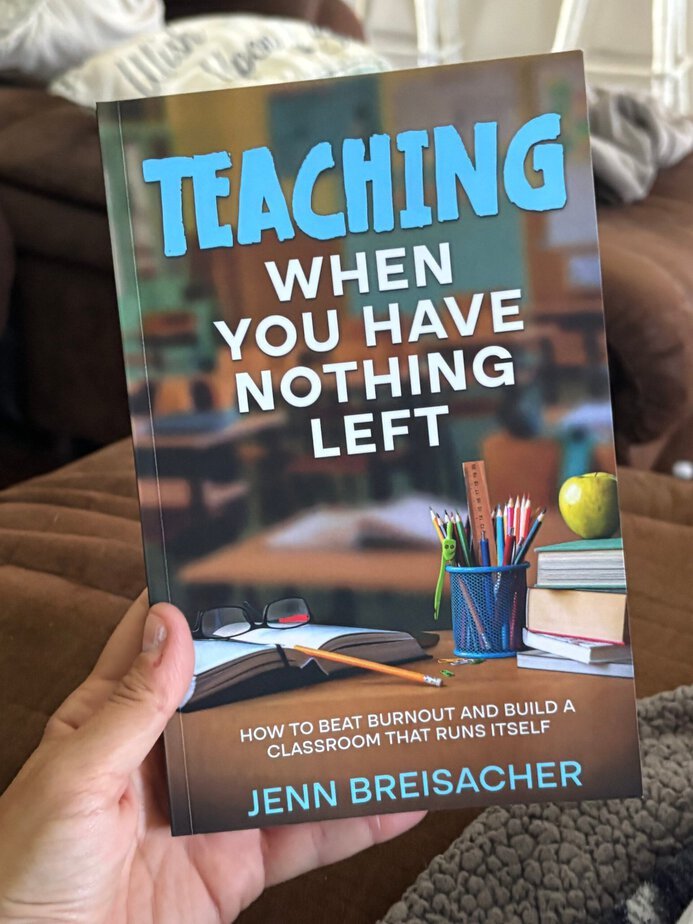
“This is exactly the book teachers need right now to reignite their passion and avoid burnout. It allows educators to dive in and make meaningful changes in their classrooms immediately.”
Amber S., 7-12 Math Teacher, Arizona
I mention my book not to be salesy, but because I wholeheartedly believe it will help every single educator who reads it to rekindle their excitement for the classroom and use new tips and strategies, OR what they’re already doing, just packaged a little differently, to make the change they’ve been hoping for but just couldn’t find.
My Honest Take
If you’re sitting there thinking, “I’m pretty sure I’ve got pieces of all three,” I’m going to tell you something that might feel counterintuitive: pick one. Just one. The one that made your stomach drop when you read it.
I’ve watched teachers try to overhaul everything at once, and I’ve done it myself more times than I care to admit. It doesn’t work. You can’t simultaneously build automated classroom systems, set hard work boundaries, and renegotiate every commitment you made last spring, all while setting up your physical classroom and writing first-week lesson plans. You’ll burn out trying to prevent burnout, which is as absurd as it sounds.
When I first started being intentional about this, really intentional, not just “this year will be different” wishful thinking, I picked the “never actually stop” type because it was the one actively destroying my health. I set a hard rule: no schoolwork after 7 pm, period. The first week, I broke it three times. The second week, twice. By week four, I was actually done by 7 pm most nights, and the world didn’t end.
That single boundary bought me back about eight hours a week. What it didn’t do was tell me what to do with those eight hours, or how to hold the line on a bad week, or what to do when a new commitment tried to sneak past it in October. That’s the part that took me years of trial and error to figure out on my own, and it’s exactly the part Teaching When You Have Nothing Left walks you through.
If you’re the “only person who knows how anything works” type, your starting point is automating two routines during the first week of school. Not ten routines. Two. Pick the ones that currently cost you the most time and energy. Morning arrival, transitions, turning in work, whatever your specific pain point is. Knowing that you should do this is the easy part. Actually building a routine a room full of kids will hold onto by week three, instead of abandoning by week two, is where most good intentions quietly die. That’s the part Teaching When You Have Nothing Left is built to walk you through before day one, not after you’ve already watched it fall apart once.
If you’re the “saying yes” type, your only job between now and the first staff meeting is to identify one thing you’re not doing this year and practice saying it out loud. “I won’t be able to take that on this year.” Say it in the car. Say it to your partner. Say it until it stops feeling like a confession and starts feeling like a fact. That sentence is the easy part…holding it the first time someone looks disappointed is what determines whether this year is different. That’s what Teaching When You Have Nothing Left helps with: not just naming the boundary, but building the plan that helps you keep it.
Pick one. Start there.
It’s a real start, but a good idea on a Tuesday night during summer has a way of quietly disappearing by the third week of September, once the fire drills, the parent emails, and the grading pile show up and take the wheel. That’s the actual gap between reading this and the year going differently: not knowing what to do, but having something solid enough to hold onto once things get loud again.
That’s what Teaching When You Have Nothing Left is for. Not another idea to remember. A plan you’ve already built, sitting right there in the book, waiting for the exact week you’ll need it most.

What is the difference between normal stress and actual teacher burnout?
Stress is temporary and situational, like what you feel during a hard week, and it typically resolves when the situation changes. Burnout is physical, emotional, and psychological exhaustion from prolonged exposure to unmanaged workplace stress that lingers even when the grading pile shrinks or the weekend arrives. You cannot yoga-breathe your way out of burnout any more than you can sleep off a broken leg, because burnout requires structural change.
Why do I feel burnt out before I have even stepped into my classroom?
Teacher burnout is not one thing, but three distinct types, and most of us spend all year fighting the wrong one. You might be the type who never actually stops working, the type whose classroom only functions when you are physically present for every routine task, or the type who has accumulated commitments because saying no never felt like an option. If you are already exhausted in August, you are likely carrying pieces of one or more of these from last year.
Is teacher burnout just about caring too much?
The “never actually stop” type of burnout isn’t about caring too much; it’s about never having a real stopping point where the day actually ends. The issue is that there is no natural finish line, and the guilt of leaving something undone often feels worse than the exhaustion of just finishing it. The fix is not time management, which you have already tried, but building an actual hard stop into your day and holding it.
Is this my fault? Am I just not cut out for teaching?
None of this is your fault, because you did not create a system that gives you thirty kids, one prep period, and a never-ending to-do list. You are not bad at your job, but you are tired because your job requires your physical presence for every single routine task, which is unsustainable by design. The problem is not you, even though the system will not fix itself.
How do I figure out which type of burnout is mine and what do I do about it?
Be honest about which of the three types resonated most deeply; the one where you caught yourself thinking is exactly what happened to me. If you are the “never stop” type, set one hard boundary like no schoolwork after 7 PM. If you are the “only person who knows” type, automate two key routines during the first week of school, and if you are the “saying yes” type, identify one thing you are not doing this year and practice saying no. The key is picking just one type to work on first, because trying to overhaul everything at once will burn you out. Also, if you haven’t yet, take the 10-question quiz.